

The New New York
Symbolic Connection and Conjecture.

Islam and 911 are obviously deeply connected. The recent mayoral election had me thinking of this relationship in symbolic terms. I also wondered if the Reflecting Pools could represent the negative space of the Kabba in Mecca.
I admit to being a little obsessed with this monument to death.
The 9/11 Memorial is often described in soothing, civic terms: remembrance, loss, resilience. But beneath the polished granite, the bronze names, the soothing waterfalls, a subtler, darker architecture pulses, one that mirrors sacred geometry while inverting its purpose.
In Kabbalistic terms, the Tree of Life charts the flow of divine energy from the infinite (Keter) down through manifestation (Malkuth). It is a ladder, a descent that is meant to be traversed consciously, with light guiding each step. The Kaaba, in Mecca, performs a similar function: pilgrims move centripetally, circling a cube, orienting themselves spiritually, drawing consciousness inward toward unity, toward presence. These are architectures of ascension and connection.
Now look at the 9/11 Memorial. Two vast square pits, the footprints of the Twin Towers, dominate the plaza. Water cascades into their centers, over edges into hidden chasms, never revealing where it goes. Here, the geometry is familiar: the square as foundation, the void as axis mundi. But everything is inverted. Instead of light drawn upward, consciousness is pulled downward. The water disappears, the gaze sinks, the visitor is choreographed into the underworld of loss rather than toward transcendence.
Step down the ramps into the museum, and the inversion deepens. The descent mirrors the path of the initiate into the Qliphoth, the shadow side of the Tree of Life, where energy flows into absence rather than illumination. You move from plaza (Malkuth, the physical) to Foundation Hall and the slurry wall (Yesod, the foundation of the subconscious), encountering relics of destruction that anchor grief like sacred objects. Every ramp, every shadow, every echoing footstep is a calculated guide into engineered psychic descent.
Beneath the reflecting pools, the hidden catch basins and pumping systems create a literal underworld. Water disappears into steel and concrete, recirculated endlessly in a cycle of absence dressed as eternity. The memorial’s “sacred center” is not the visible surface, but this unseen machinery, its currents echoing a ritual of control: grief is funneled, contained, framed. In Kabbalistic terms, it is an inversion of Yesod: the foundation channeling loss, not creation; entropy, not light.
Viewed through this lens, the memorial becomes a temple of orchestrated shadow, a modern inversion of the Kaaba’s centripetal sanctity. Pilgrims circle the void, gaze into the infinite abyss, descend into memory, and ascend again, but they have been guided not by divinity, but by human design. Every choice of material, slope, waterfall, and light is a subtle manipulation of consciousness, a choreography of grief performed as ritual.
The oak trees, the reflective pools, the bronze names, all are props in a liturgy of absence. Even the sunlight filtering across the plaza feels calibrated, casting shadows along the edges of the void, echoing the geometry of a cosmic inversion. Where traditional sacred architecture elevates, here the axis mundi draws downward. Where it unites with the infinite, here it stages a controlled encounter with emptiness.
The 9/11 Memorial is not merely a monument to loss. It is an engineered underworld, a space in which grief is ritualized, absence made palpable, and the visitor’s psyche choreographed through descent into shadow. The design mirrors sacred patterns, Kabbalistic, archetypal, cosmic, but flips them: what is usually a conduit of divine light becomes a conduit of human-engineered darkness.
It is architecture as occult psychology, an inversion temple where the altar is absence, the sacrament is grief, and the deity is the void itself.
Both the Kabbalah and the Kaaba deal with structure and connection between heaven and earth:
The Kaaba is a physical cube, an axis where heaven and earth meet.
The Kabbalistic Tree of Life is a spiritual structure, a metaphysical map linking divine and human realms.
Both involve circulation, the pilgrim around the Kaaba, the flow of divine energy through the sefirot.
So, while not etymologically related, they are philosophically resonant, both describe a sacred architecture of connection between above and below, the infinite and the finite. Is it a coincidence that the towers were destroyed by “Muslim extremists” ( according to the official story) and the monument that replaced them was designed by an Israeli, Michael Arrad?
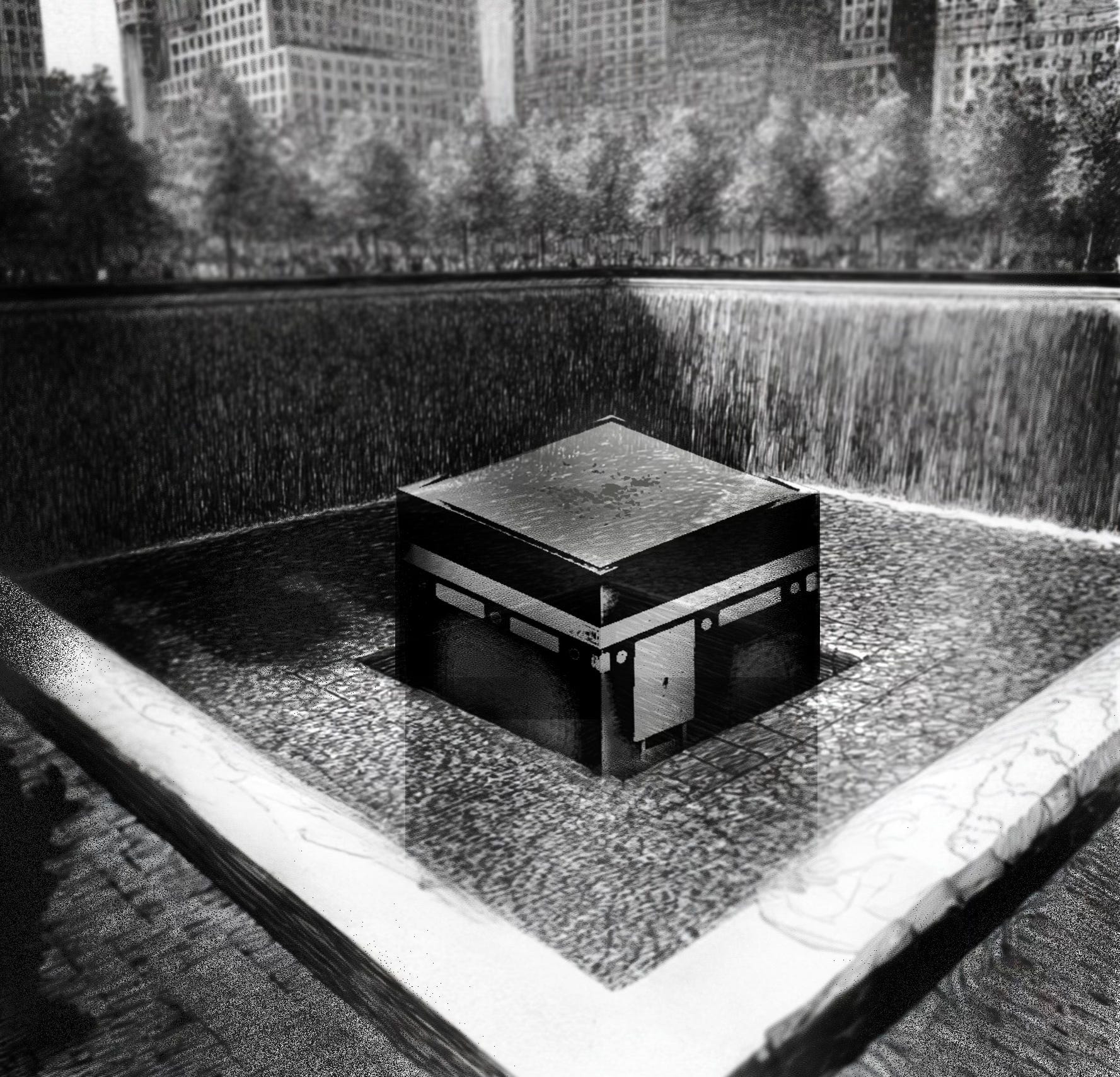
The Kabba would very roughly fit in this space as shown here. It would be somewhat smaller than illustrated.
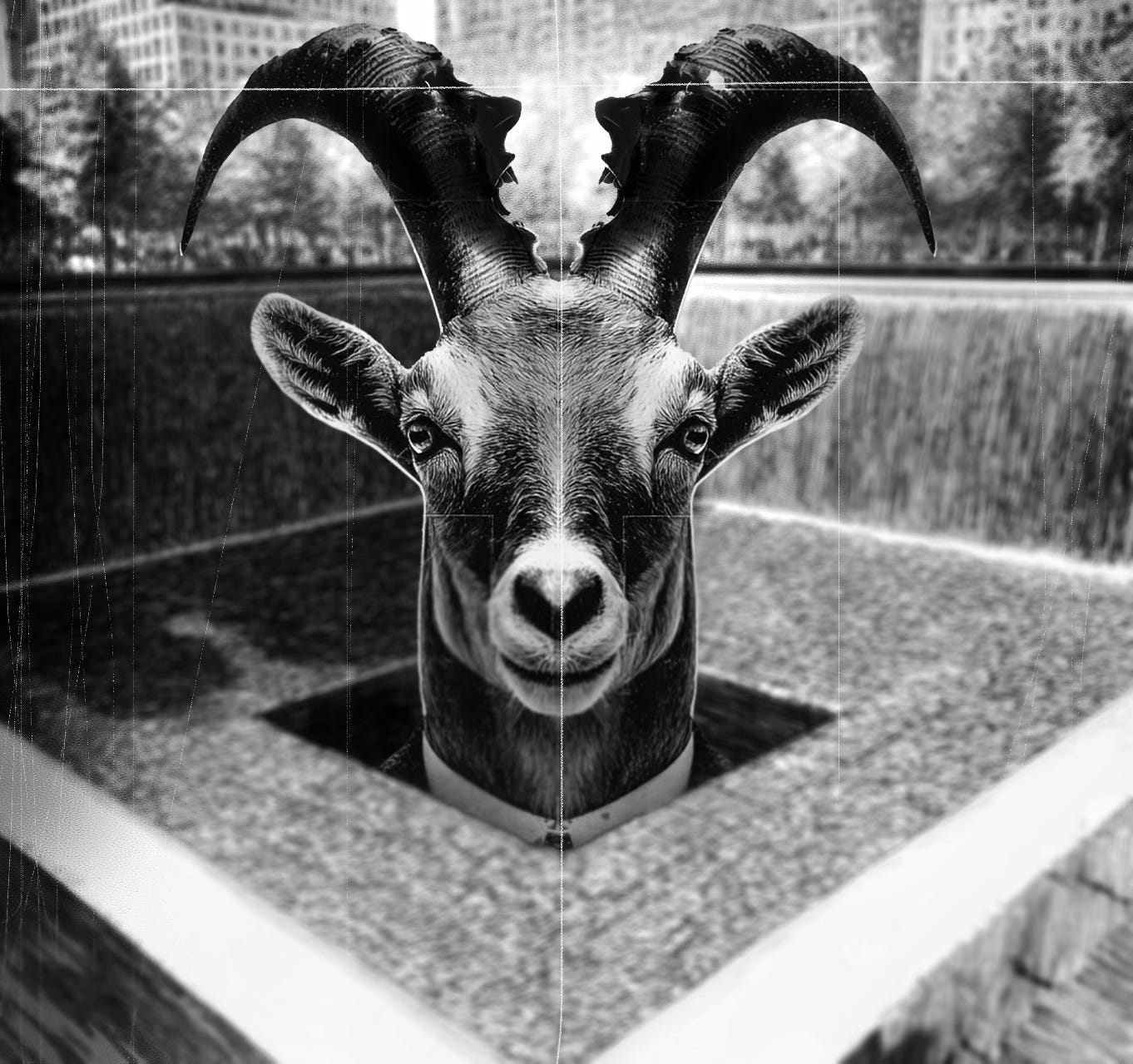
It's also weird that the airplane looking sculpture is there (but it's not supposed to remind you or an airplane, so stop it) and it's called the Oculus.
"absence made palpable" Absolutely.