


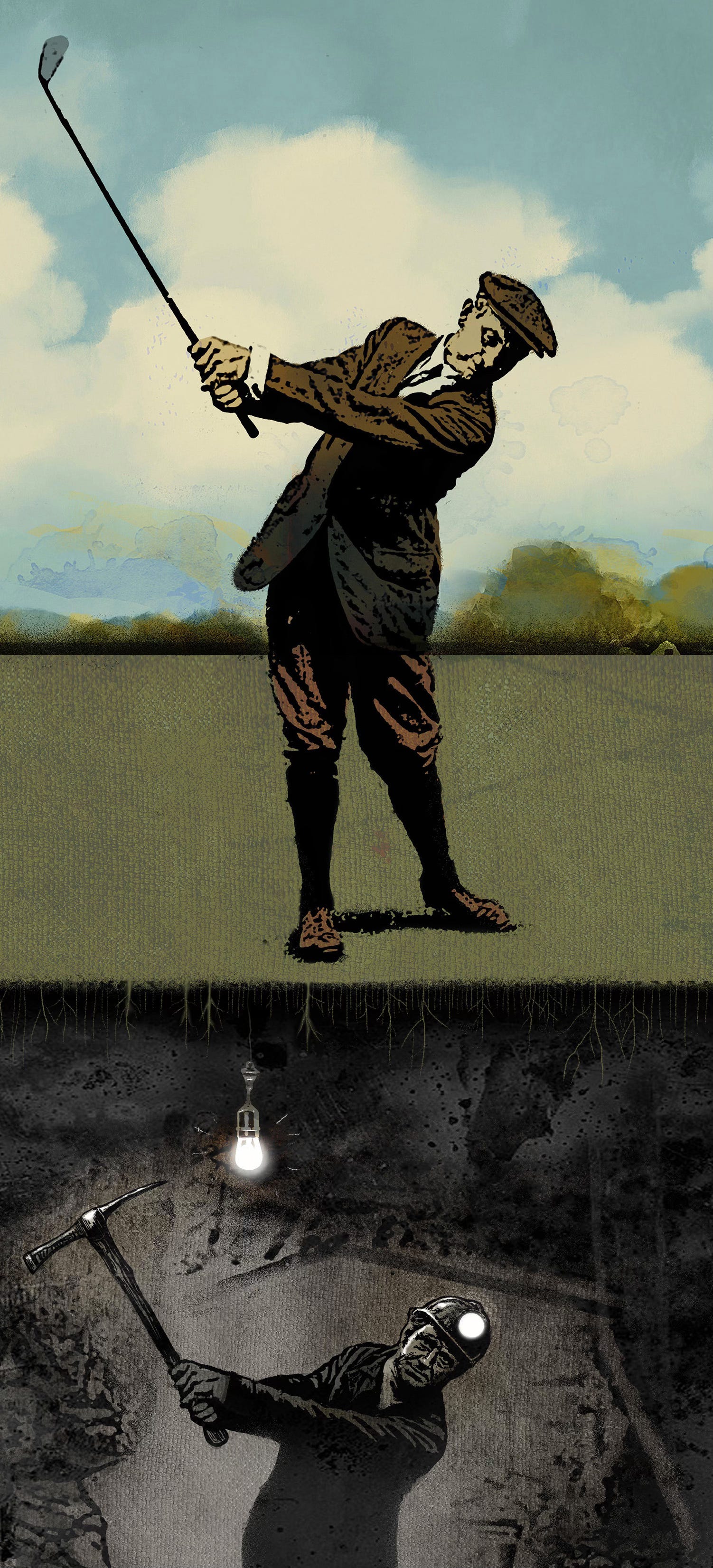
There is a machinery of human heart and toil that pumps mere miles away from and feeds the Kardashian Kingdom of the Hamptons.
This place is only 30 miles from the sprawling “Summer Cottages” of the elite on a map, but it may as well be on Alpha Centuri. It lies in another dimension. No spacious wine cellars here, cooled to the temperature of old money, just sweat and grit.
I am accustomed to getting paid a decent sum for drawing, or manipulating pixels in Photoshop in the comfort of my studio. But I took a summer job in a Fed Ex processing center out of curiosity, as a side hustle and to see if I could hack it.
(My humble version of “Down and Out in London and Paris”, by George Orwell)
The experience brought me to my knees.
Early summer is an especially busy time for this facility. A high percentage of the packages are shipped to tony summer homes on Long Island’s East End. Those accoutrements for the affluent are not going to deliver themselves. At least not yet.
The gig begins at 3:15 in the morning in a fluorescent warehouse at 100 Orville Drive in Bohemia, under a silent and black Long Island sky. My job is called “Van Line”
Our job is to scan the packages rolling down the conveyor belt and stack them next to the appropriate truck for delivery.
I arrive, properly caffeinated. I know I won’t have a single moment to sip a cuppa Joe for the next five hours. The boxes flow endlessly on to the conveyor belt. Midsize boxes mostly. Decorative sea-grass baskets. Monogrammed pool towels. A golf clu
b that cost more than our weekly salary. Then heavy patio furniture for the folks who take a 15 minute helicopter ride from Manhattan to The East End. You don’t expect them to take the Third Worldly Long Island Rail Road or sit in four hours of Expressway traffic, do you? (Naming this cursed road the “Expressway” was a cruel joke, I am sure.)
Every tenth box arrives like a punishment from God.
A 140-pound air conditioner.
A marble table base.
An unholy cube with no handles and the density of a collapsed star. The super-sized boxes are called IC. Which stands for “Incompatible” (They don’t fit on the conveyor belt.) These monsters require several of us just to move onto a dolly. You get a hernia just looking at these things.
And the belt never stops.
Neither do you.
Five-hour shifts. No break. (The law requires six hours of labor to be break-worthy.) Just movement. Lift. Turn. Scan. Stack. Repeat until your nervous system becomes part of the conveyor machinery.
You discover very quickly that white collar fatigue is mostly theatrical. “Burnout” means something different when your forearms are trembling from moving heavy boxes of premium dog food for four straight hours while sweat runs into your eyes.
One morning I was mysteriously and terrifyingly left alone to process the items on one conveyor belt. A task usually delegated to three or four of us. Eight trucks waiting to be filled.
I worked as fast as I could, but speed becomes meaningless against volume. I was moving like an octopus on meth. The packages kept coming with the mindless indifference of ocean waves. At one point I looked up toward the chute feeding the belt below it. I braced myself for impact. Boxes were cascading on to each other like a an avalanche of corrugated cardboard. We processed 24,000 packages that morning. I did my best, but I was overwhelmed. Thankfully, help came soon enough to save me from complete failure and termination. The lifers who work there could have easily handled the handling. There are about 100 workers in the Bohemia warehouse.
These folks don’t watch Ted Talks. They learn about life and acquire wisdom in a more visceral and honest way.
Our Amazonian civilization is held together by these unseen people of hardened flesh and bone.
The workers around me carried themselves with the exhausted dignity of draft horses. Some had been there twenty years. Lifers. Veterans of the endless river.
One woman, maybe sixty, maybe older, warehouse years age people differently, caught a falling package with one arm and muttered:
“I’m getting too old for this shit.”
But her eyes said something more profound.
There was desperation there, but also determination. This dynamic tension of contrasts filled me equally dissonant emotions. I was in awe of her and pitied her at the same time.
She had the look of someone who has been cornered by life but refused to kneel. She was working to feed her loved ones, and also to prove that no matter how brutal life could be, she would not submit. She is a warrior.
These people were breaking their bodies for $21.25 an hour. Every penny extracted physically, like coal from a mine. No abstractions. No “leveraging synergies.” Just vertebrae and tendon converted directly into economic output.
One worker was seventy-one years old.
Seventy-one.
A thin but lead pipe-hard old man who rode his bicycle to work every morning in the dark and outworked kids fifty years his junior. He moved with the economy of someone who had spent decades negotiating gravity professionally.
Not Planet Fitness strength.
A physique sculpted not for vanity, but for necessity.
Worker strength.
The kind forged through repetition and necessity.
He knew exactly how to pivot under weight. Exactly how to catch a sliding package without destroying his shoulder. He carried himself with the quiet precision of an old mechanic handling volatile machinery. He understood leverage like he was Archimedes.
Watching him was humbling.
A white collar professional can spend his entire life talking about resilience without ever understanding what resilience actually looks like. Real resilience is a seventy-one-year-old man loading trailers at dawn because stopping is not an option.
He knew the job was killing him.
But there was something unbroken in him.
Something modern professional culture cannot manufacture artificially through mindfulness seminars or corporate retreats.
Dignity.
Not performative dignity.
Earned dignity.
The dignity of knowing your labor is real.
By sunrise, the trucks roll out toward the East End carrying their sacred cargo to the summer palaces of the hedge fund managers and other One Percenters. Outdoor pizza ovens. Lawn sculptures. Forty-pound air purifiers for homes larger than medieval monasteries.
I don’t think the people ordering this stuff would last an hour in the warehouse. This knowledge gives the workers a sense of pride and self-respect. Most of the luxury economy rests atop an invisible foundation of people who are not afraid to get their hands dirty. (In a good way.)
The Hamptons culture exists because somewhere, before dawn, somebody’s lower back absorbed the weight of their luxury. Literally. The aristocrats sip thousand dollar bottles of wine beside infinity pools while an army of exhausted night workers in Bohemia keeps the river flowing. Like anonymous monks tending an empire’s furnace.
And despite the brutality of it, there is honor there too.
Not romantic honor. Not cinematic blue-collar mythology.
Just the stark human nobility of enduring difficult things without complaint because survival itself has become a discipline.
By 8:30 in the morning the shift ends, depending on volume.
The sun rises.
The belt stops.
Everyone limps back to their cars or bicycles. If they took an Uber to work, it would eat half their salary. Many are on their way to their “day job”. They call it “moonlighting”, and I’m afraid to ask what sort of further toil awaits them.
The trucks are now loaded and off to their routes. And for a moment the warehouse becomes quiet enough to hear the ringing in your joints.
Then tomorrow morning at 3:15, the Bohemian river flows again.
That was awesome! I really enjoyed reading about your experience working in the trenches of consumerism. People don't typically think about the amount of work that goes into all of the stuff and things they buy, whether it came off a store shelf or via a delivery truck. Working in any consumer driven blue-collar job is exhausting, mentally and physically. "I'm too old for this shit." is my daily mantra but that sense of accomplishment you get from getting your hands dirty is hard to ignore. It's all very Sisyphean.
This is really great writing. I'm very impressed and properly reminded of the strength - both physical and in character, the values and dignity of hard working people -that you as well possess. The Food Lady has it right too. Thank you so much for going in there and reporting on a "day in the life of". You are remarkable!